


By: Dipak Kurmi
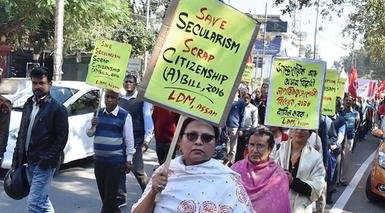
The conflagration kindled in Assam is diffusing throughout India. Paradoxically, dissension towards the recent Citizenship Amendment Act (CAA) is being expressed by the North-East and the remainder of the nation for distinct rationales. It is worth noting that the CAA, enacted in December 2019, grants expedited citizenship to Hindu, Sikh, Buddhist, Jain, Parsi, and Christian migrants from Pakistan, Afghanistan, and Bangladesh who arrived in India before 2015 but omits Muslim migrants. The Act has been met with widespread criticism and has sparked protests across India.
After triumphing over the Congress party in the 2016 Assembly elections, and venturing into the North-East, the BJP appears to be in no mood to relinquish its hold on its territorial stronghold. Consequently, the government is formulating laws to mollify the region. The Citizenship Amendment Act is aimed at the core of the 1985 Assam accord, which stipulates that March 1971 is the cutoff year for determining citizenship. Despite this, New Delhi is resolute in its determination to implement Clause 6 of the accord, which guarantees the preservation of the Assamese cultural identity.
Related Posts:


To quell the public’s fury, Himanta Biswa Sarma, a prominent figure of the BJP (Bharatiya Janata Party), not the Chief Minister, declared during a news conference that the land rights of the “indigenous” people of Assam would be protected. The sale of land to non-residents of the state will be prohibited, similar to the regulations in Jammu and Kashmir where land is solely for genuine residents of the former state. The BJP considered Article 35A to be a major barrier to the development and progress in Kashmir, but it is a different scenario in the North-East. The contentious issue would be determining who is a native resident. Sarma indicated that the panel established to consider the implementation of Clause 6 will also define the criteria for identifying indigenous and non-indigenous residents.
According to Sarma, “A Himanta Biswa Sarma can sell to a Chandan Brahma but a Himanta Biswa Sarma cannot sell to an infiltrator, whether he has come in 1951 or 1971…not even if he has come in 1941.” What does this mean? Will Bengali Muslims, who were granted citizenship under the NRC, be denied the fundamental right to purchase or sell property? This would add a new dimension to the rights of Bengali Muslims who were approved as citizens, had voted, and had the appropriate documentation. Sarma, however, stated that while the government had its definition of “indigenous” people, he would leave it to the committee established to protect the state’s cultural identity to establish this.
Essentially, the message from Sarma’s press conference is that Bengali Muslims, irrespective of when they entered Assam, will have no land ownership rights. This is a potentially dangerous majoritarian stance.
However, when the Assam government releases the notifications and makes all the details public, the situation will become more transparent. During the British colonial rule in India, Bengali Muslims were brought into Assam to clear the swampy areas of the Brahmaputra valley. Despite being born in India, their descendants may not have the right to land in Assam due to their Muslim faith. The original cut-off date of the Assam Accord in 1971 was chosen in recognition of the birth of Bangladesh as a separate country. However, the BJP has changed this to 2014 through the Citizenship Amendment Act to include Hindu Bengali “refugees” from Bangladesh in their agenda. The BJP has defended the exclusion of Muslims from the CAA by arguing that they have other Muslim-majority countries to turn to, whereas Hindus have only India to seek refuge. This has raised concerns over the discriminatory nature of the CAA, which some have criticized for being a majoritarian proposition that undermines the secular principles of India.
The government intends to take steps to safeguard the Assamese language and culture. A law will be enacted to prevent the sale of land around Vaishnavite sites. The Centre will amend Article 345 of the Constitution to make Assamese the state language. All schools in the state, including those that use English, Hindi or Bengali as the medium of instruction, will be required to teach Assamese up to class X. The issue of language has always been a contentious one in Assam, and it has resulted in Assamese-Bengali riots in the past. However, these measures will not be extended to the Barak Valley, which has a Bengali majority. Additionally, the autonomous areas and hill districts in the state will be exempt from these measures.
Not only Assam, but other North-Eastern states are equally concerned about the large influx of ‘outsiders’ such as Bengali Hindus, Muslims, and Indians from other states, settling in their region. To ensure that outsiders do not disturb the existing balance, Arunachal Pradesh, Mizoram, and Nagaland have a British-era law called the Inner Line Permit (ILP), which requires special permission for anyone, including Indian citizens, to enter these states. Now, this law has been extended to Manipur, and Meghalaya is expected to follow suit. This law, ostensibly aimed at monitoring the movement of outsiders, also implies that land cannot be sold to outsiders. Thus, the majority of North-Eastern states will now have laws that prohibit not only alleged Bangladeshi immigrants but also Indian citizens from acquiring land in the region. In effect, this is a variation of Article 35A, which was applicable to Kashmir but has now been given to the North-East under a different name. (The author can be reached at dipaknewslive@gmail.com)