


HT Correspondent
TEZPUR, Feb 9: Researchers from Tezpur University have made a significant advance in solar physics by uncovering a new mechanism through which energy is transported from the Sun’s surface into its lower atmosphere, offering fresh insights into solar activity and space weather phenomena.
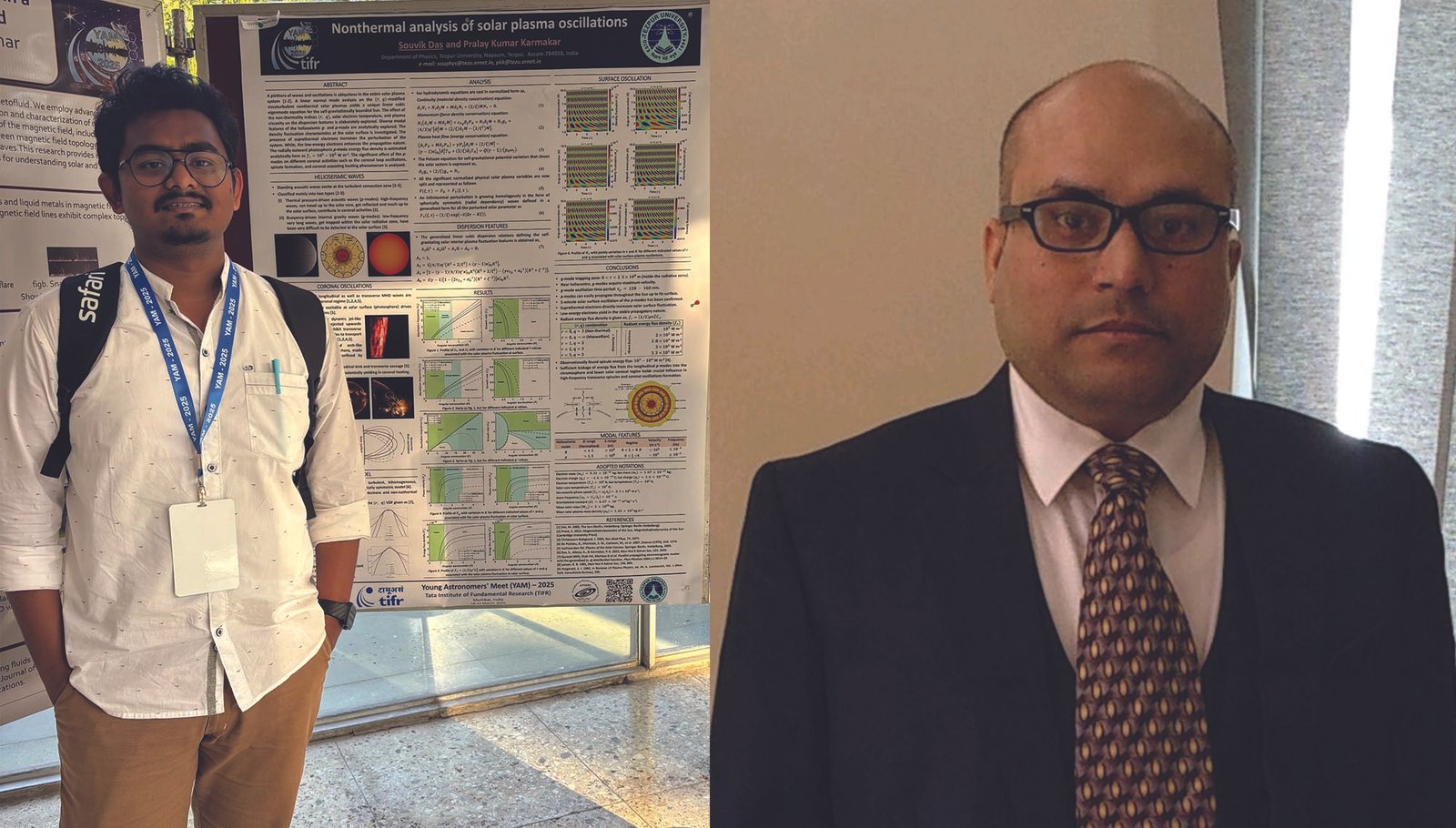
The study, titled “Analysis of Solar Surface Oscillations and Energy Transport with Bispectral Electronic Thermostatistics”, was carried out by Souvik Das, senior research fellow (DST-INSPIRE), and Prof Pralay Kumar Karmakar of the Department of Physics.
Related Posts:



It has been published in The Astrophysical Journal, a leading international journal published by the American Astronomical Society.
The research focuses on understanding how energy generated on the Sun’s surface is transported upward, a long-standing problem closely linked to solar magnetic activity, eruptions and space weather that can affect Earth’s magnetic environment.
The Sun’s surface is known to vibrate continuously due to sound-like waves called five-minute solar oscillations, causing it to behave like a giant resonator.
These oscillations are believed to play a role in carrying energy into the solar atmosphere, but the detailed processes governing their evolution and interaction with energetic particles have remained unclear.
In the new study, the researchers developed an advanced theoretical model that incorporates both low- and high-energy electrons in solar plasma.
Unlike earlier models, this approach accounts for the influence of fast-moving, high-energy nonthermal electrons on surface oscillations.
The findings show that strong nonthermal effects weaken certain pressure-driven oscillations, known as p-modes.
As the population of high-energy electrons increases, the strength of these oscillations decreases, indicating that energetic particles can suppress wave activity and modify how acoustic energy is redistributed in the Sun’s lower atmosphere.
This transported energy can act as an additional source to drive spicules, microspicules and atmospheric waves, contributing to the heating of the solar chromosphere and corona, which are much hotter than the Sun’s visible surface.
“Our results show that some fast oscillations on the Sun’s surface can carry much more energy than previously thought. At the same time, strong nonthermal effects can suppress certain oscillations, offering a clearer picture of how energy is balanced and transported in the Sun’s atmosphere,” Das said.
The team also proposed a new hybrid decay model to explain how p-mode-driven energy gradually diminishes as it moves upward. Instead of vanishing abruptly, the energy fades steadily with height due to combined atmospheric and magnetic effects, helping scientists better estimate how much energy reaches different layers of the Sun.
The theoretical predictions were validated using observational data from the Helioseismic and Magnetic Imager onboard NASA’s Solar Dynamics Observatory and from Japan’s Hinode Solar Optical Telescope, confirming the real-world relevance of the findings.
“This work clearly demonstrates how suprathermal electron populations can strongly influence solar surface oscillations and energy transport, successfully bridging theoretical modelling with observational evidence,” Prof Karmakar said.
Scientists note that a clearer understanding of energy transport in the Sun is crucial not only for fundamental astrophysics but also for improving predictions of solar storms that can disrupt satellites, power grids and communication systems on Earth.