

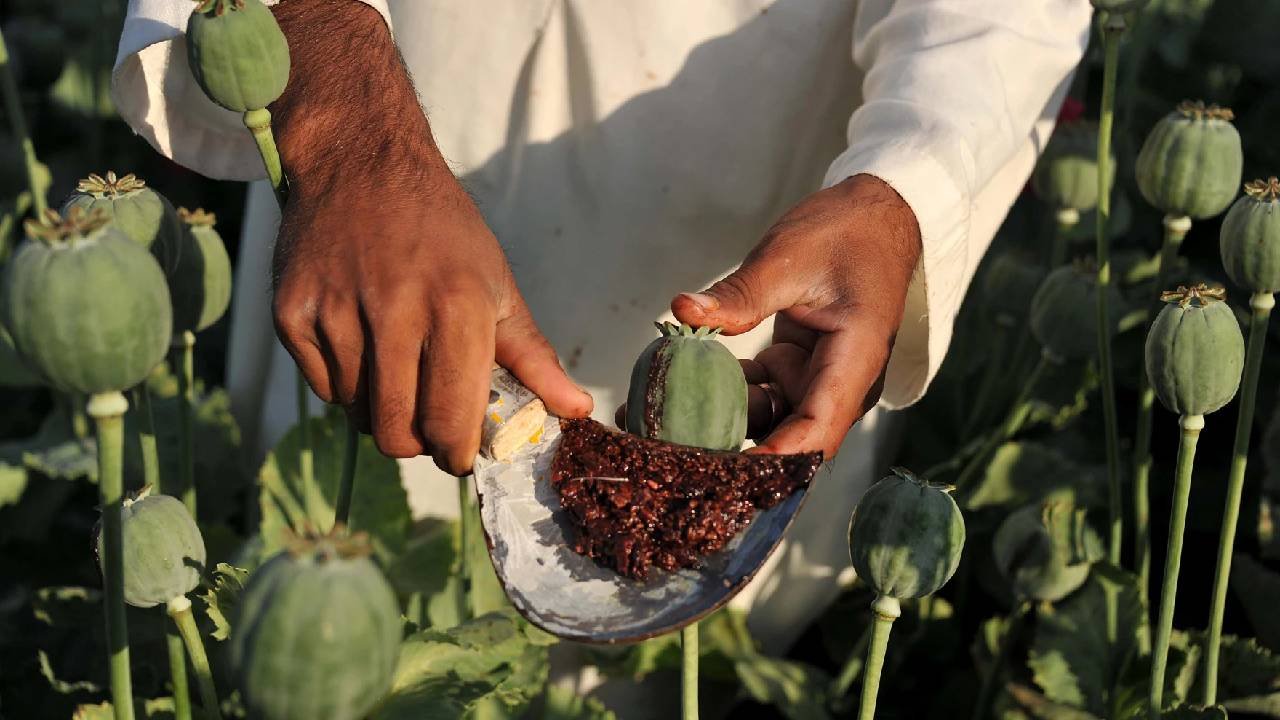
NEW DELHI, June 27: The threat of drug trafficking from across the Myanmar border into India’s north eastern states and up to the hinterland has “dramatically” escalated due to more than 50 per cent expansion of illicit opium cultivation and production in the neighbouring country, as per a latest report.
The document published by the federal anti-drug agency Narcotics Control Bureau (NCB) for 2025, added this development in Myanmar is an “accelerated” threat as it is the “single most important supply zone” for the global gap left after the “dramatic collapse” of Afghanistan opium.
The report said the 1,643-km-long India-Myanmar international border functions as a “major” entry point for methamphetamine and heroin from the Golden Triangle region, “exacerbated” by porous terrain and the Free Movement Regime (FMR), particularly across Manipur, Mizoram, Nagaland and Arunachal Pradesh.
Related Posts:




India is geographically wedged between the Golden Crescent on its northwestern side (Pakistan-Afghanistan-Iran) and the Golden Triangle on its northeastern flank (Thailand-Myanmar-Laos). These are the two prolific drug-producing regions of the world.
“Despite the 2022 Taliban drug ban, which reduced opium production by 93 per cent from its peak (in Afghanistan), UNODC (United Nations Office on Drugs and Crime) notes that stockpiles remain sufficient to meet demand through 2026.
“It would be analytically imprudent, however, to interpret this contraction as a diminishing threat to India,” it said.
On the other hand, the report said, Myanmar’s illicit opium production increased by over 50 per cent between 2020-24, with the area under poppy cultivation reaching 45,200 hectares.
This makes the India-Myanmar border the “single most important substitute supply zone for the global gap left by Afghanistan collapse.”
India’s eastern borders are the “most direct and porous” entry point for this expanding production base, and the consequences are already visible, the report said, pointing to the 140 per cent increase in Amphetamine Type Stimulant (ATS) seizures recorded in India between 2020-2025, culminating in 8.2 tons seized in 2024 alone.
“This is the clearest empirical signal of how dramatically the eastern threat has escalated,” it said.
The northeastern states of Manipur, Mizoram and Nagaland are bearing the “sharpest” frontline exposure.
The porous border mechanism, including the erstwhile free movement regime along the India-Myanmar border, has created conditions under which the states have transitioned from peripheral transit zones to active staging grounds for distribution into the Indian hinterland, the report said.
It went on to say that the second major trafficking corridor enters India through Champhai in Mizoram, which shares close proximity with Myanmar’s Chin state. Drugs are smuggled through unfenced and porous border stretches and routed towards Silchar in Assam’s Barak valley through Aizawl and adjoining road networks.
Thereafter, the contraband moves towards Meghalaya and further reaches Guwahati, from where it is “distributed” across mainland India.
The report quoted the UNODC World Drug Report 2025 to say that Myanmar produced 995 tonnes of opium in 2024, which was 50 per cent higher than in 2020.
The NCB report also mentioned that the “most consequential” result of the collapse of the Afghan opium supply was that it has been “redistributed” and “diversified” and this drug was flowing eastward into India.
“The broader implication is that India’s western exposure is shifting from being a high volume heroin transit problem to a more complex, multi-substance, tech-enabled smuggling problem,” it said.
The report also alleged the use of Internet-based communication platforms for drugs trafficking, especially Telegram. “Encrypted messaging platforms such as Telegram, WhatsApp and Signal have emerged as significant channels for drug distribution globally, including in India,” it claimed.
Unlike darknet markets that require specialised access, these platforms are widely accessible via smartphones, lowering entry barriers and enabling broader reach, the report said.
“Among these, Telegram has become a prominent platform for drug advertising with public channels offering product listings, pricing and delivery details to large subscriber bases,” the report charged.
Telegram was recently banned in the country during the re-NEET exam.
Talking about its internal issues, the report said the NCB was facing a “critical” shortage of manpower in its legal wing as only one post was occupied out of the 38 sanctioned as of December, 2025.
Similarly, all seven sanctioned posts of technical and cyber cadre were unfilled, highlighting a “significant gap” in NCB’s digital enforcement capabilities, as per the report. (PTI)