

By: Kamal Baruah
Nothing will stop me in my quest for an adventure to the Old Silk Road, where mules used to transport goods through a mountain pass called Nathu La, way back in the 19th and early 20th century of the British Empire. The rugged terrain of winding road through the front windshield to view the meandering path over the sharp cliffs didn’t end my enthusiastic, while capturing the natural beauty of Sikkim with DSLR on a long drive. The striking mountain scenery, unique flora and wildlife remained off-limits to travellers for five decades after Chinese aggression in 1962. It was reopened in 2006 with limited trade, now it serves as one of the major trading border checkpoints with the Tibet Autonomous region at nearby Sherathang during June-September. Nathu La is one of the locations where geography has significantly influenced its history of Silk Road.
The erstwhile Persian Royal Road (500 BC -300 BC) became the major artery of the Silk Route. It began in Persia (Iran) through Turkey in the Mediterranean Sea. In time, the road branched out into Greece, Rome and Britain and eventually crossed India through Nathu La. Finally it went down into Egypt and the African continent through the sea route of Indian Ocean. However, Egypt and the West came into contact with China in only 200 BC because of its Silk. The rice spices especially from Sikkim also exported along the route. After the Black Death pandemic devastated Europe in 1347-1351, the region of all kinds of merchandise got disconnected thus European Monarchs were to undertake naval exploration that led to the age of Discovery (1453-1660 AD).
Related Posts:



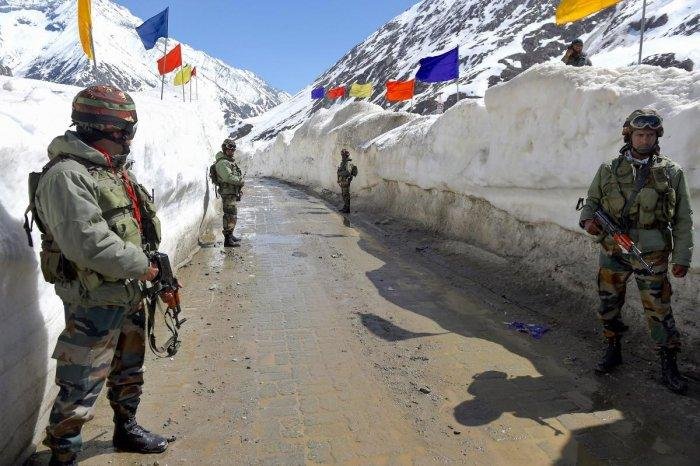
The stairs leading to the peak at 14,420 feet elevation to the final lap of the ‘Nathu La’ gate, Indian Army welcomed tourists by offering chocolates at the steep path and issued with a note of caution ‘you are under observation, no stopping, no halting and no photography’. It was shivering cold of sudden dip in temperature and I experienced the coldest time as chilly winds swept in the air. The barren hillside were shrouded in mist and covered by thick clouds. A cloud of tiny water droplets suspended on my face. Atone point of time; I felt breathlessness at that height facing altitude sickness. My chest heaved, lungs burning, but I couldn’t catch my breath for some time.
Nathu La holds strategic importance. Surprisingly there is no fencing; it’s the McMahon Line, the boundary between British India and Tibet agreed as part of the 1914 Simla convention under the chief negotiator Sir Henry McMahon, then foreign secretary of the British-run Government of India, spanning 890 km along northeast India and northern Burma. In 1950, Tibet lost its status as an independent territory and India took control over Tawang. After 1962 debacle, Indian Army enhances self-esteem at Nathu La in 1967. However, Beijing claims Arunachal as South Tibet.
The lively presence of People’s Liberation Army in olive green made visitors so cheerful. I felt totally unnerved to meet with one PLA. I was trying to communicate but he quietly left me nodding head without answering. The site was like barbed wire frontier. On the other side, few Chinese were doing bricklaying and tiling along the borderline that probably annoyed the Punjab Regiment. PLA skirmished with nearby Indian infantrymen over the open border all of a sudden. Soldiers pushed each other; the Cavalry charged up the hillbut both sides were trying to avoid further hostilities. Fortunately, no firearms were used or shots fired during the clash. A 1996 agreement prohibited the use of guns and explosives near the border. Shocked onlookers watched in the hostile region.
While the troops engaged in border, skirmishing happens often at irregular open formation. The purpose is to delay enemy’s movement, disrupt attack, or weaken morale. Subsequently, China engaged strengthening military infrastructure all along the LAC stretching from Ladakh to Arunachal. The stand-off at Doklam 2017 opened up Chinese cobweb plan of fresh tangled territorial incursion. After the Galwan Valley face-off 2020, PLA established military base near Pangong Tso in 2021. In last October, a clash had broken out between Bum-La and Yangtse peak at 17000 ft. Yangtse has huge advantage to have a clear line of sight to the Sela Pass, 75 km west of Tawang and the only link to forward posts.
The root cause of India and China facing off against each other at LAC in the Himalayan region is an ill-defined 3440 km long disputed border. The Indian part of the Line currently serves as the de facto boundary, although its legal status is disputed by China and rejecting Simla Accord and the McMahon Line. There are many border areas of differing perceptions and both sides patrol the area up to their claimed lines. The two nuclear power nations are also competing to build infrastructure along the border. Till no so long, Indian army would only patrol in the Yangtse in the Tawang sector but now started staying at the post even in harsh winter. That surprised PLA troops, who intruded to gain access the foot peak but Indian Army contested in a firm and resolute manner to PLA’s bid to unilaterally change the status quo forcing them to retreat. Soldiers move to the mountain to strengthen it against the enemy lines thus happening skirmish at the perceived border. While PLA has already moved with combat readiness of its troops, IAF isn’t far behind. It plans to conduct air combat drill in NE amid LAC tension.