
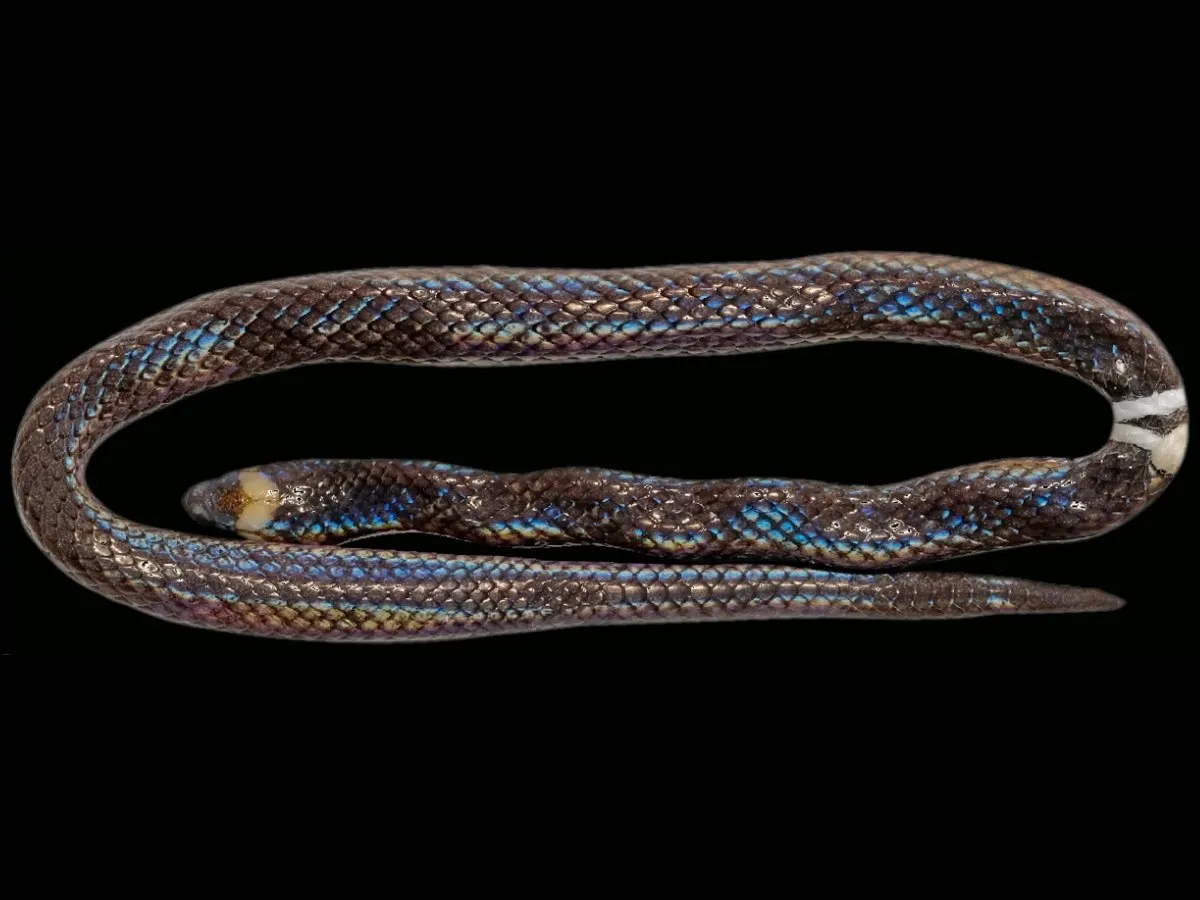
NEW DELHI, Sept 12: Researchers stumbled upon the dead remains of what eventually turned out to be a new species of snake, a discovery they said pointed to a “large gap in sampling” in north and northeast India for reptiles.
The discovery is described in a research published in the Journal of Asia-Pacific Biodiversity.
On December 16, 2021, an international team, including researchers from the Banaras Hindu University, Uttar Pradesh, recovered the body of a four-foot long vine snake on the outskirts of the Valmiki Tiger Reserve in Bihar.
Related Posts:




“The species differs from most others in being either green or brown with an orange brown belly; the vertebral (spinal) scales are keeled unlike any other member of the genus Ahaetulla Link, 1807. Lastly, the snout is quite long compared to other species of the genus,” the study’s corresponding author Zeeshan Mirza, a PhD student in the Department of Integrative Evolutionary Biology, Max Planck Institute for Biology, Germany, told PTI.
The Ahaetulla Link, 1807 genus consists of mildly venomous, tree-harbouring snakes dispersed in parts of south and southeast Asia.
“Molecular data further attested to the distinctiveness of the Bihar and Meghalaya population, which is described here as a new species,” the authors wrote.
For the molecular analysis, genomic DNA was taken from tail or liver tissues of the Bihar specimen, a male one from Meghalaya, a specimen of A. flavescens from Arunachal Pradesh, and four specimens of Ahaetulla from Sagaing District, Myanmar, the researchers described.
The discovery from the low-elevation plains highlights the uniqueness of this region, Mirza said.
The authors also pointed to a “large gap in sampling in north and northeast India for reptiles, including Ahaetulla”.
Among the north Indian states, Bihar and Uttar Pradesh are by far the least explored for reptiles and amphibians, they said.
“The region has been neglected in the past but is likely home to more unique species like the new vine snake species. It is hoped that the new species can drive more researchers to focus on documenting the region’s biodiversity,” Mirza said.
When asked if he had an idea where else in India the species could be found, Mirza shared that following the publication of the research, he received images of the snake species from Jaldapara in West Bengal.
“Based on this, I (believe) that the new species would be widespread across the low-elevation regions north of Ganga and Brahmaputra river. This would mean in the states of Bihar, Jharkhand, West Bengal, Assam and possibly Arunachal,” he said.
The authors said the description of another Ahaetulla species from India was “not surprising” as recent contributions have largely focussed on the Western Ghats and north Eastern Ghats.
“… further exploration of the Gangetic plains and the bordering Shivalik Hill range is warranted,” they wrote. (PTI)