


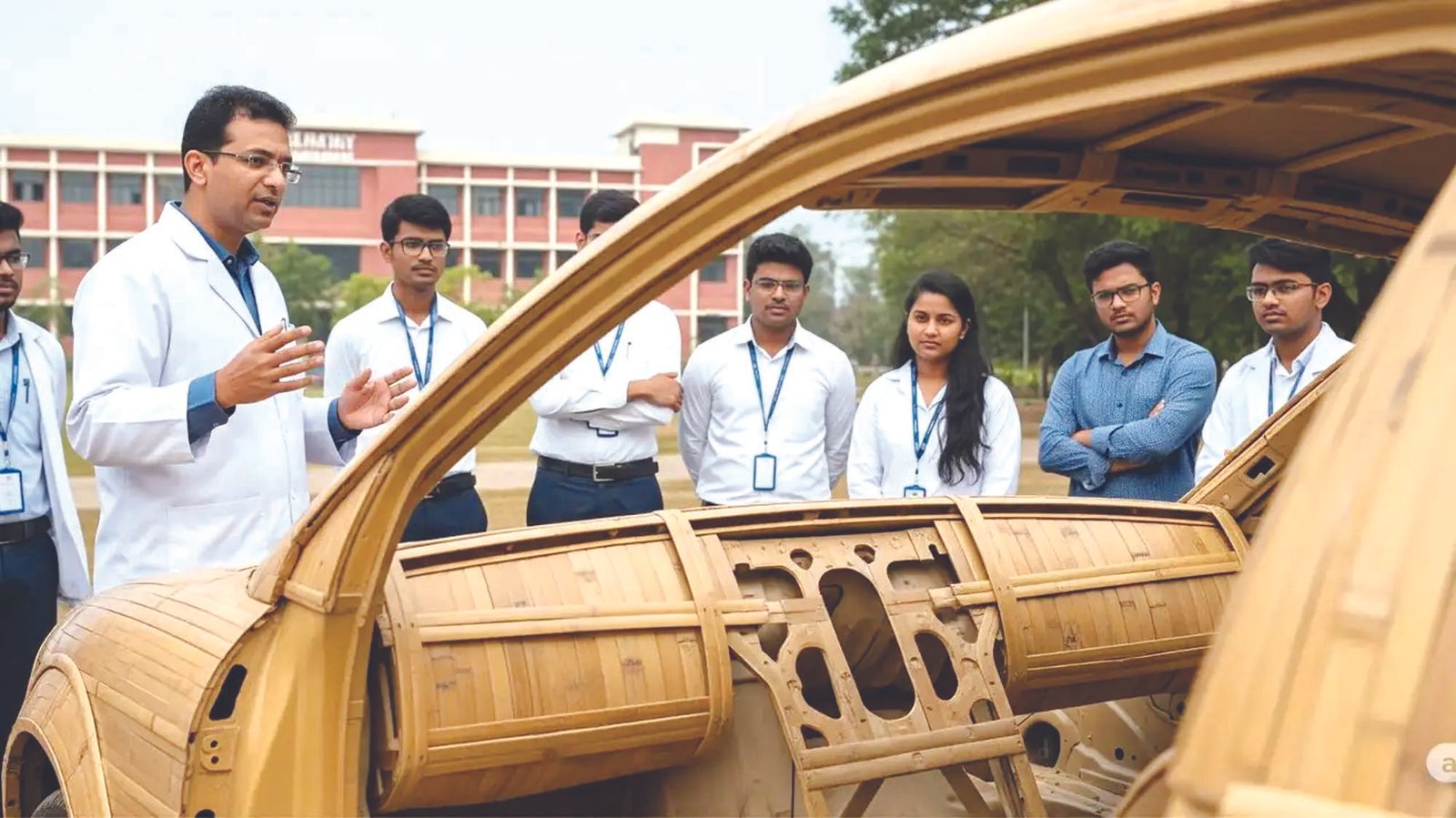
NEW DELHI, July 24: Researchers at the Indian Institute of Technology (IIT), Guwahati, have developed an eco-friendly composite material made of ‘Bambusa tulda’, a fast-growing bamboo species in northeast India, combined with biodegradable polymers, officials said on Thursday.
Due to its properties, such as high strength, thermal stability, low moisture absorption and cost effectiveness, the developed composite is a suitable replacement of conventional plastics used in automotive interiors.
The findings of this research have been published in the prestigious journal, Environment, Development and Sustainability (Springer Nature).
Related Posts:


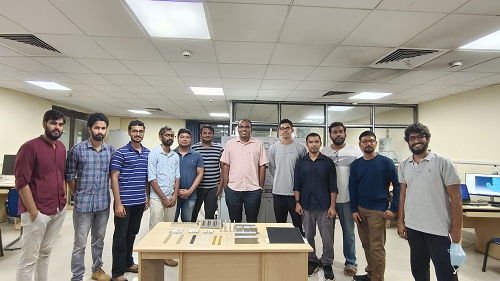

Led by Poonam Kumari, Professor, Department of Mechanical Engineering, the research not only addresses the problem of plastic waste, but also provides a solution to the growing global demand for greener materials, particularly in the automotive manufacturing industry.
“The researchers tested four bamboo-based composite formulations consisting of Bambusa tulda fibres reinforced with bio-based or petroleum-based epoxies. By treating the bamboo fibres with alkali, the team improved its compatibility with the base polymer, resulting in enhanced durability for real-world use.
“The developed formulations were then evaluated on 17 different parameters to test their tensile strength, thermal resistance, impact durability, water absorption and cost per kilogram, among others,” Kumari said.
While these formulations had distinct strengths, none of them had all the properties to provide a balanced and high-performing option. To identify the same, the team used Multi-Criteria Decision-Making (MCDM), a structured evaluation method.
“The results observed bamboo composite made with bio-based epoxy FormuLite as the best performing option with low moisture absorption, significant thermal stability, and mechanical strength. The cost-effective nature of the composite, priced at Rs 4,300 per kilogram, makes it an eco-friendly solution for automotive parts, such as vehicle dashboards, door panels and seat backs, among others,” she said.
“Developed composite can be used for designing components/parts in consumer electronics, automobiles, aerospace and sustainable building materials etc. The product will replace wood/iron/plastic components and will have similar cost and lead to fulfilment of SGD goals. This development is in line with Make in India policy under Green Tech Revolution,” she added.
The team is currently conducting a full life cycle assessment of the developed composite to measure its environmental impact from production to disposal. As the next step, the research team is planning to apply industrial techniques such as compression modelling and resign transfer to scale up the production. (PTI)