
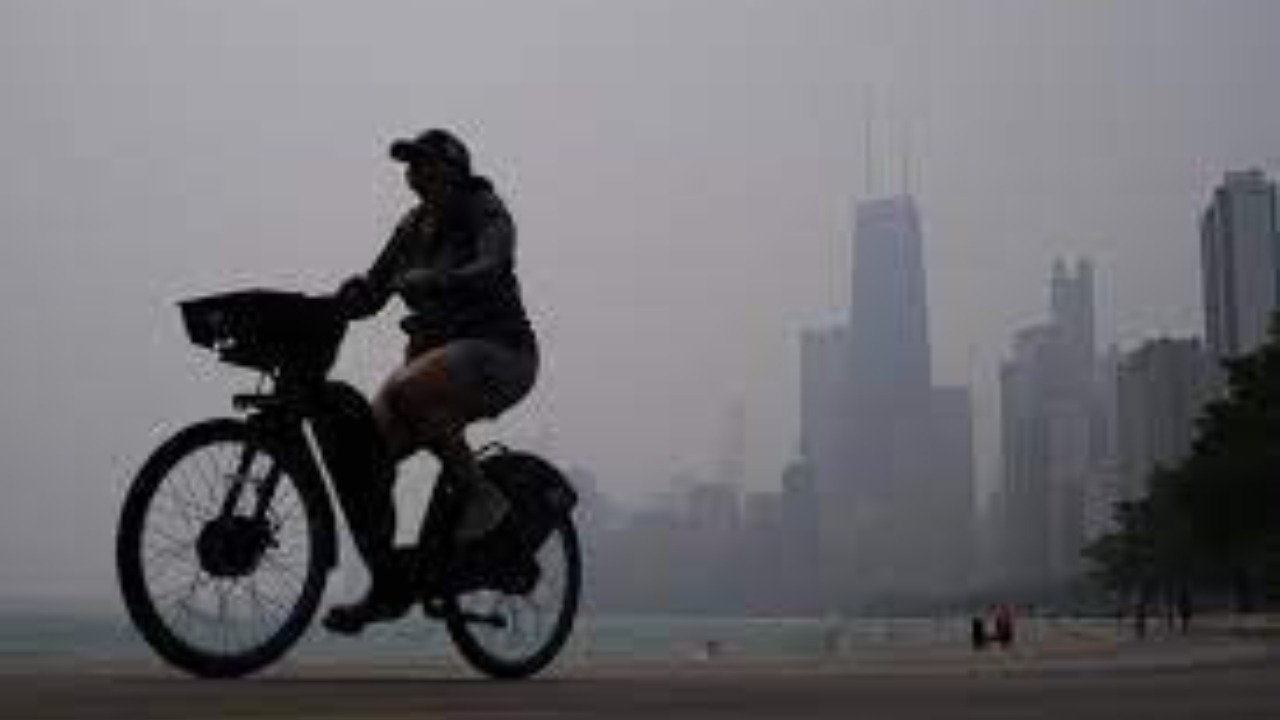
CHICAGO, June 28 (AP): The haze of unhealthy air that settled over Chicago and other Great Lakes cities on Tuesday reminded U.S. residents from the Midwest to the Northeast and as far south as Kentucky to brace for more depending on which way the wind blows as Canadian wildfires rage on.
“Until the fires are out, there’s a risk,” said Bryan Jackson, a meteorologist with the National Weather Service. “If there’s any north component to the wind, there’s a chance it’ll be smoky.”
Drifting smoke from the ongoing wildfires across Canada created curtains of haze and raised air quality concerns throughout the Great Lakes region and in parts of the central and eastern United States. The Environmental Protection Agency’s AirNow.gov site showed parts of Illinois, lower Michigan and southern Wisconsin had the worst air quality in the U.S., and Chicago, Detroit and Milwaukee had air quality categorized as “very unhealthy.”
Related Posts:


In Minnesota, a record 23rd air quality alert was issued Tuesday through late Wednesday night across much of the state, as smoky skies obscured the skylines of Minneapolis and St. Paul, Michigan’s Department of Environment, Great Lakes, and Energy issued an air quality alert for the entire state. Wisconsin’s Department of Natural Resources also issued an air quality advisory for the state.
In Chicago, officials urged young people, older adults and residents with health issues to spend more time indoors.
“Just driving into the zoo … you could just see around the buildings, kind of just haze,” said Shelly Woinowski, who was visiting the Lincoln Park Zoo in Chicago.
Some day care centers in the Chicago area told parents that their children would remain indoors on Tuesday due to the poor air quality, while one youth sports club said it adjusted its activities to add more time indoors.
“As these unsafe conditions continue, the city will continue to provide updates and take swift action to ensure that vulnerable individuals have the resources they need to protect themselves and their families,” Mayor Brandon Johnson said in a statement.
Fires in northern Quebec and low pressure over the eastern Great Lakes are responsible for the smoke, Jackson said. He added that a north wind would push the smoke further south, moving into southern Illinois, Indiana and Kentucky overnight.
The Canadian Interagency Forest Fire Centre reported Monday that 76,129 square kilometers (29,393 square miles) of land including forests has burned across Canada since Jan. 1. That exceeds the previous record set in 1989 of 75,596 square kilometers (29,187 square miles), according to the National Forestry Database.
Nationally, 490 fires are burning, with 255 of them considered to be out of control.
Even recent rainfall in Quebec likely won’t be enough to extinguish the wildfires, but the wet weather could give firefighters a chance to get ahead of the flames, officials said Tuesday.
Nearly a quarter of the fires burning in Canada are in Quebec. Environment Canada meteorologist Simon Legault said he expects rain to stop falling by Wednesday morning in the regions most affected by forest fires.
Earlier this month, massive fires burning stretches of Canadian forests blanketed the northeastern United States and the Great Lakes region with smoke, turning the air yellowish gray and prompting warnings for people to stay inside and keep windows closed.
The small particles in wildfire smoke can irritate the eyes, nose and throat, and can affect the heart and lungs, making it harder to breathe. Health officials say it’s important to limit outdoor activities as much as possible to avoid breathing in the particles.
In early June, U.S. President Joe Biden said in a statement that hundreds of American firefighters and support personnel have been in Canada since May and called attention to the fires as a reminder of the impacts of climate change.
The warming planet will produce hotter and longer heat waves, making for bigger, smokier fires, said Joel Thornton, professor and chair of the department of atmospheric sciences at the University of Washington.