
HT Correspondent
KEYI PANYOR, Oct 14: In the heart of Arunachal Pradesh, the young district of Keyi Panyor is quietly redefining what people-first governance can look like.
At the centre of this change is Deputy Commissioner Shweta Nagarkoti, IAS, whose administration is guided by a clear and focused roadmap — the “Six Core Goals for 2025” — built around three simple principles: listening to people, acting on facts, and continuously improving through feedback.
Related Posts:




Since taking charge, DC Nagarkoti has sought to make governance more open, accountable, and practical.
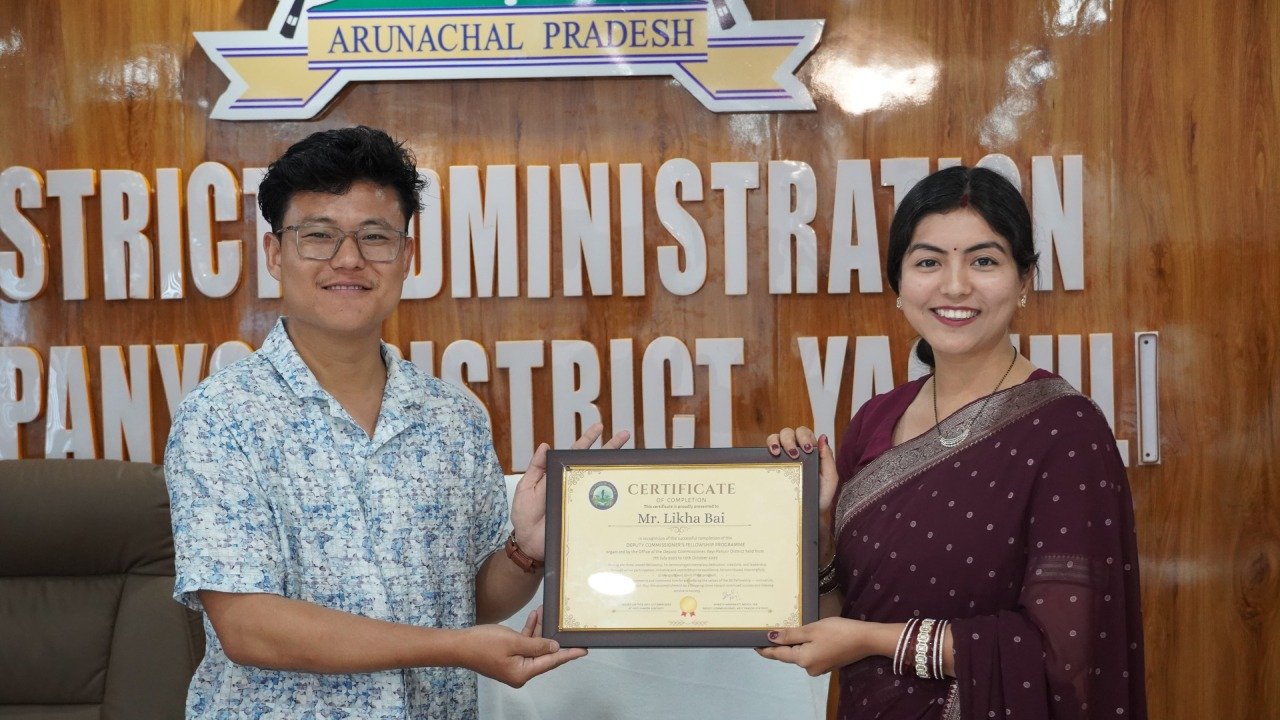
A cornerstone of this vision is the Deputy Commissioner Fellowship Programme (DCF), launched in July 2025, which brought in bright young professionals to work directly with the district administration.
After a rigorous selection process involving a written test and viva-voce, three fellows were selected: Likha Caral, a doctoral researcher from New Delhi; Likha Bai, a Ph.D. scholar from Rajiv Gandhi University; and Toko Yapung, an MA graduate in Psychology.
Together, the DC and her fellows have become the district’s innovation engine, driving planning, fieldwork, data analysis, and reporting across vital sectors including education, health, environment, and rural development.
Education was identified early as Keyi Panyor’s most urgent challenge.
Research by the DCF team revealed that poor school performance stemmed not from students but from systemic issues — teacher absenteeism, weak accountability, and poor administrative supervision.
In response, DC Nagarkoti, in coordination with the District Deputy Director of School Education (DDSE), launched a Cluster-wide School Inspection and Accountability Drive from July 14–18, 2025.
The inspections uncovered inflated enrolment data and frequent teacher absences without leave.
Thirty-five teachers were issued show-cause notices, and several headmasters were replaced to restore leadership and discipline.
The administration simultaneously moved to fix infrastructure and resources.
Urgent repairs were carried out at NSCBAV Lichlith and Government Residential School, Kugi Tago, including ceiling and window repairs, electricity connections, and furniture provision.
Water filters were installed at GSS Pitapool, ensuring safe drinking water for students.
Teacher reshuffling helped address shortages in key subjects, while coordination with the Education Department resolved widespread textbook scarcity.
The administration also mobilised Anganwadi workers through the local CDPO to support nearby schools.
To bring structure to classroom learning, the DCF team designed class-wise academic session plans aligned with the syllabus and school calendar.
These plans provide a clear timeline for lessons, ensuring students stay on track and teachers maintain consistent progress across all subjects.
Recognising that students often lacked motivation or clear goals, DC Nagarkoti launched the Vision Board Initiative — a creative exercise encouraging each classroom to display students’ names alongside their dream careers.
Using simple materials, schools transformed their walls into canvases of ambition.
The initiative spread quickly –– of 26 schools visited, 19 adopted Vision Boards enthusiastically.
Teachers reported greater student participation, while parents expressed pride in their children’s aspirations.
Complementing this, the Wall of Fame was introduced to celebrate achievements in academics, sports, and extracurricular activities — turning classrooms into spaces of recognition and inspiration.
Citizen engagement forms the foundation of governance in Keyi Panyor.
The administration launched Voice of Keyi Panyor, a public feedback platform where residents’ opinions directly shape administrative actions.
This culture of shared responsibility inspired the Clean and Green Keyi Panyor Mission, anchored by the simple but effective “Har Ghar Se Ek Dustbin” campaign.
Under this initiative, 100 artistically designed dustbins were distributed along the Pitapool–Joram road, giving every household a tangible role in maintaining cleanliness.
Further along the same stretch, digital art boards now display public service messages in English and Nyishi — addressing issues such as drug awareness, cleanliness, and cultural pride.
By pairing public messaging with practical action, the district has effectively woven civic responsibility into everyday life.
In another first, the administration launched Design My Keyi Panyor, a public competition to create an official district logo.
The initiative received enthusiastic participation, and the winning design — now officially adopted — stands as a symbol of collective ownership and pride in local identity.
To institutionalise open communication, the DCF team also introduced DC Samvad (DC Dialogue) — a monthly public meeting between the Deputy Commissioner, officials, and citizens.
The forum allows people to raise issues directly, propose solutions, and receive time-bound responses.
Each meeting ends with a clear roadmap of follow-up actions, ensuring no concern goes unheard.
This initiative has significantly improved public trust and administrative responsiveness across the district.
The district’s next focus is on sustainable tourism and youth empowerment.
Plans are underway to develop eco-friendly trekking routes, camping sites, and cultural circuits that showcase Keyi Panyor’s natural and cultural heritage while creating local livelihoods.
Upcoming wellness drives, mental health campaigns, and sports programmes aim to strengthen youth confidence and community well-being.
Under DC Shweta Nagarkoti’s leadership and with the energy of the DCF team, Keyi Panyor is steadily turning its vision into reality.
The Six Core Goals for 2025 — once a roadmap — are now reflected in the district’s daily functioning. Accountability, innovation, and empathy have become the hallmarks of governance here, setting Keyi Panyor apart as a model of people-centred administration in Arunachal Pradesh.