


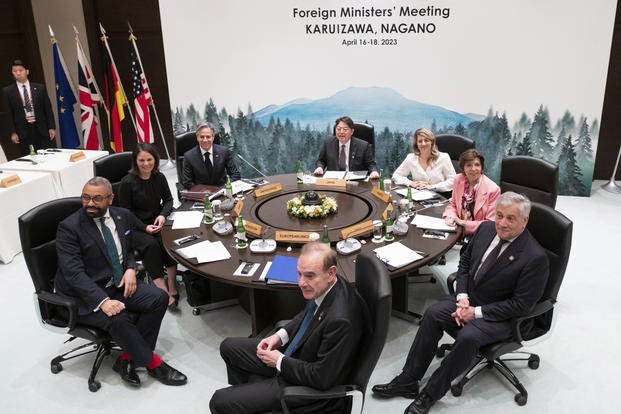
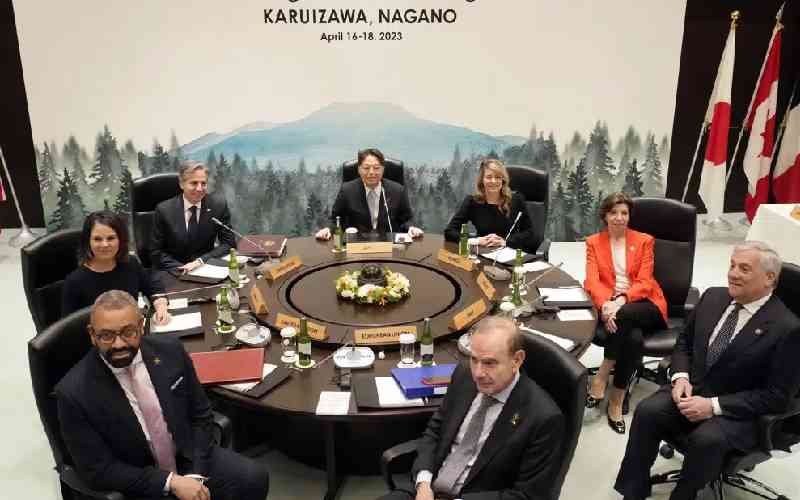
KARUIZAWA, April 18 (AP): Top diplomats from the Group of Seven wealthy democracies vowed a unified front against Russia’s war of aggression in Ukraine, saying at the close of their meetings on Tuesday that they were committed to boosting and enforcing tough sanctions against Moscow.
The G-7 communique laying out their commitments also included strong words meant to curb what the ministers see as increasing Chinese and North Korean aggressiveness in Northeast Asia.
But it was Russia’s invasion of Ukraine that highlighted the three-day summit in this hot spring resort town.
Related Posts:

“There can be no impunity for war crimes and other atrocities such as Russia’s attacks against civilians and critical civilian infrastructure,” the ministers said.
“We remain committed to intensifying sanctions against Russia, coordinating and fully enforcing them,” the communique said, and would support “for as long as it takes” Ukraine as it defends itself.
The foreign ministers’ document was prepared as a template for global leaders to use at a G-7 summit that will be held in Hiroshima next month, and included language about Iran, Myanmar, Afghanistan, nuclear proliferation and other “grave threats.”
But two crises stood out: China’s increasing assertiveness against, and military maneuvers around, Taiwan, the self-governing democracy that Beijing claims as its own, and Russia’s invasion of Ukraine. Russia’s current offensive is largely stalled and Ukraine is preparing a counteroffensive, but there’s widespread global worry about the Russian leader’s repeated threats to use tactical nuclear weapons.
“Russia’s irresponsible nuclear rhetoric and its threat to deploy nuclear weapons in Belarus are unacceptable,” the ministers said.
The G-7 envoys from Japan, the United States, the United Kingdom, France, Germany, Canada, Italy and the European Union have underlined that their meeting in Karuizawa marks a crucial moment in the world’s response to Russian and Chinese aggression, two crises that are seen as challenges to the post-World War II rules-based international order.
Global efforts to confront the matters at the United Nations have been stymied by Chinese and Russian intransigence on the Security Council.
Leaders and foreign ministers of G-7 countries, most recently France and Germany, have recently concluded visits to China, and there is growing worry after China recently sent planes and ships to simulate an encirclement of Taiwan.
Beijing has also been rapidly adding nuclear warheads, taking a tougher line on its claim to the South China Sea and painting a scenario of impending confrontation.
The G-7 ministers said that peace and stability between China and Taiwan in the Taiwan Strait is “an indispensable element in security and prosperity in the international community,” and they called for “the peaceful resolution of cross-Strait issues.”
On Taiwan, “there is clear unanimity in the approach we are taking,” US Secretary of State Antony Blinken told reporters of his talks with other ministers in Karuizawa.
“What I heard was a remarkable convergence on concerns related to (China) and what we’re doing to address those concerns,” he said.
On stalled discussions with the Chinese, Blinken said the United States placed a premium on keeping communications channels open as President Joe Biden and Chinese leader Xi Jinping agreed to last year.
“My expectation would be that we will be able to move forward on that, but it does require China to make clear its own intentions in doing that,” Blinken said.
The communique also urged China to “abstain from threats, coercion, intimidation or the use of force.
We remain seriously concerned about the situation in the East and South China Seas. … There is no legal basis for China’s expansive maritime claims in the South China Sea, and we oppose China’s militarization activities in the region.”
Despite indications, notably comments from French President Emmanuel Macron, that the G-7 is split over China, US officials said in Karuizawa that there is a shared worry among G-7 nations over China’s actions, and a desire to continue a coordinated approach on working with Beijing even as nations confront Chinese coercion and attempts to water down or circumvent international rules regarding trade and commerce.