


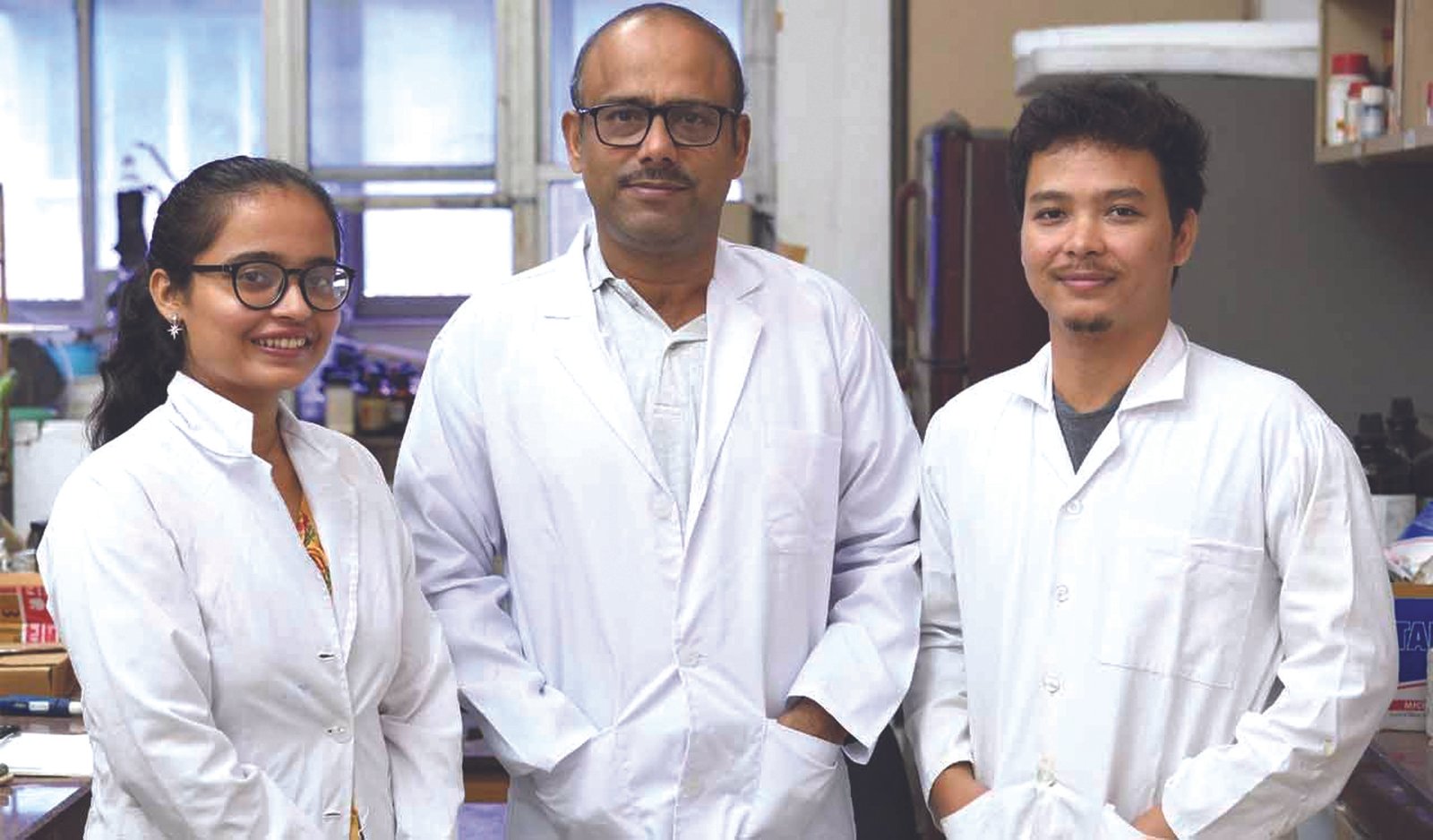
NEW DELHI, Nov 10: Indian Institute of Technology (IIT), Guwahati researchers have developed novel material that can detect adulteration or contamination of kerosene in petrol and clean oil spills, according to officials.
The same material also holds the potential to selectively absorb oil from water and solidifies it, they said.
The findings of the research have been published in the prestigious journal, Chemical Engineering.
Related Posts:
Gopal Das, Professor, Department of Chemistry, IIT Guwahati said oil spills in oceans are among the most damaging environmental disasters in the world and lead to the loss of marine life, coastlines, and livelihoods that depend on them.
According to the ‘Oil Tanker Spill Statistics 2024’, in the year 2024, 10,000 tons oil spilt into the oceans and seas globally. Oil spreads quickly and widely on water, making cleaning a challenging task. To address this, chemical absorbents, or other steps, which includes burning the oil, often lead to secondary pollution.
“To address this challenge, we have developed a Phase- Selective Organogelator (PSOG) molecule, a special class of safe materials. The PSOG was rationally designed to undergo hierarchical supramolecular self-assembly process which ultimately leads to oil gelation. It can trap oils such as kerosene and diesel through a self-assembly process, similar to how soap molecules organise themselves in water.
“Once they trap the oil, they form semi-solid gels that can be easily removed without disturbing the water below. Our developed PSOG possesses a unique ability to selectively form gel only in presence of some specific oil samples, namely kerosene, and diesel among vast range of studied organic solvents as well as oil samples,” Das said.
Such highly selective PSOG might also be useful in targeting some specific oil samples from a complex mixture of different oil samples, and recovery of the same from different water bodies.
“So, this work might give a new direction in the future developments of PSOGs for water remediation as well as detection of different fuel adulteration. Another potential use of the developed organogel is to detect the adulteration of Kerosene. In India, especially among low-income groups, Kerosene is sometimes adulterated with petrol to reduce the running cost of automobiles or household cooking.
“This is a dangerous combination as the adulterated fuel is highly flammable and has caused multiple Kerosene stove explosion accidents in the country. As the next step, the research team aims to advance the research towards detecting various types of fuel adulteration. Additionally, the team is also working on enhancing the efficiency of the detection process by refining the design and functionality of the gelator molecule,” he added. (PTI)