

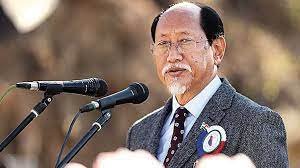
KOHIMA, Jan 27: Nagaland Chief Minister Neiphiu Rio has expressed the need for comprehensive discussions before implementing the proposed fencing of the India-Myanmar border.
The central government’s decision to end the Free Movement Regime (FMR) with Myanmar and seal the international border has sparked concerns and opposition in the Northeast.
Neiphiu Rio addressed the contentious issue of fencing along the India-Myanmar border, emphasizing the importance of open dialogue before any implementation.
Related Posts:


While speaking to reporters, Rio acknowledged the complex dynamics of the region, stating, “Nagaland is bordered by Myanmar, and on both sides there are Nagas. There has to be a workable formula.”
He further emphasized the need to find a solution that addresses the concerns of the people and prevents infiltration.
“If the need arises, then we have to work out a formula on how to solve the issue for the people and prevent infiltration as well,” he added.
The central government’s decision to end the Free Movement Regime (FMR) with Myanmar and seal the international border has been met with opposition from various organizations in the Northeast.
Among those expressing dissent is the National Socialist Council of Nagaland-Isak-Muivah (NSCN-IM), which vehemently opposes the proposed boundary fencing.
In a recent statement, the NSCN-IM asserted its stance against boundary fencing, stating that it violates the rights of the Naga people and further divides the Naga family as a nation. The group emphasized the need for free movement from both sides, describing the government’s move to abolish the time-honored Free Movement Regime as a “rude shock.”
The situation has raised tensions in the region, and as discussions unfold, the central and state governments will likely engage with various stakeholders to find a balanced solution that addresses security concerns while respecting the unique socio-cultural landscape of the region.
Rio reflects the complexity of the issue and the importance of inclusive decision-making in matters affecting border security and regional relationships.