

HT Correspondent
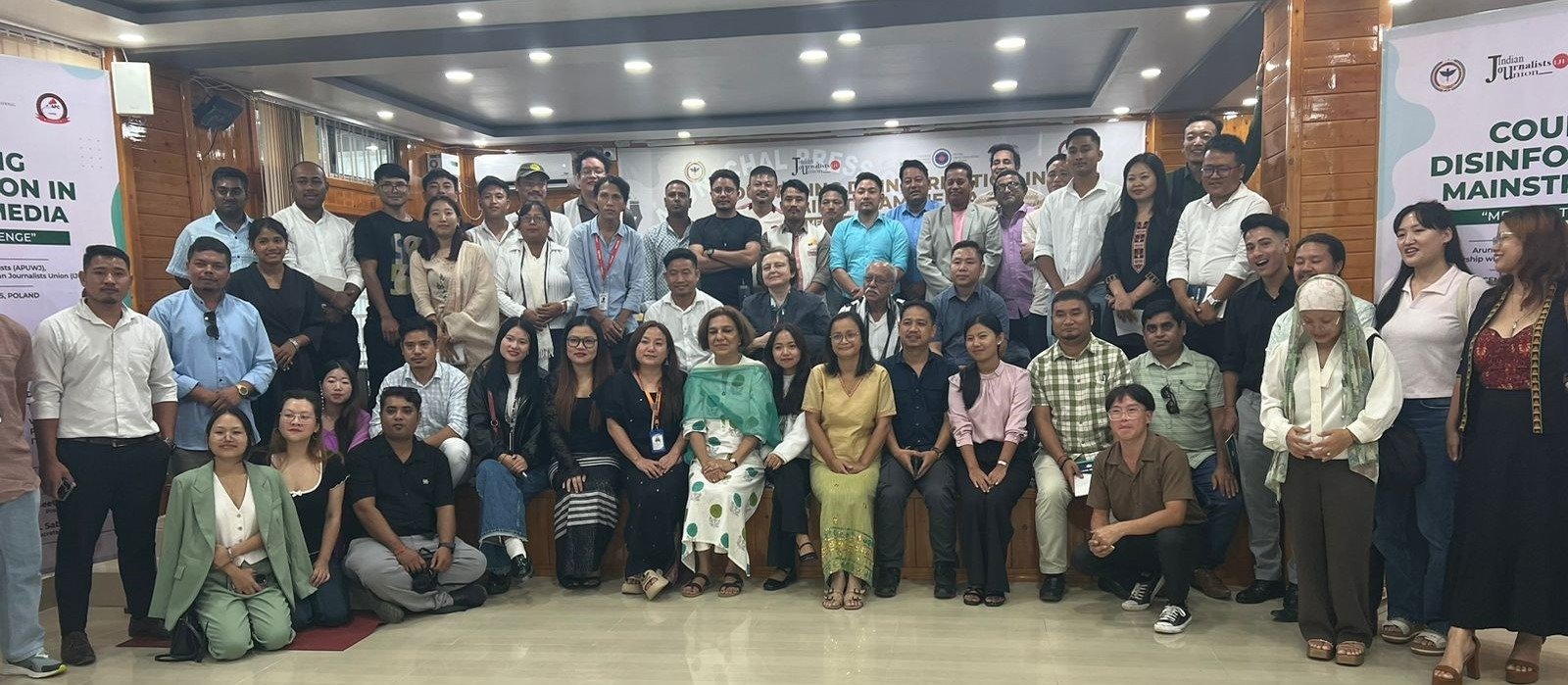
ITANAGAR, Aug 21: A workshop on “Countering Disinformation and Misinformation in Mainstream Media” was organised on Thursday at the Arunachal Press Club (APC).
The programme was conducted by the Arunachal Pradesh Union of Working Journalists (APUWJ) in collaboration with the APC and the Indian Journalists Union (IJU), with support from the Centre for International Relations, Poland.
Related Posts:



According to an official statement, the workshop brought together senior media professionals, scholars, and government officials to deliberate on one of the biggest challenges confronting the media in the digital age.
The event was graced by Prof Dr Malgorzata Bonikowska, President of the Centre for International Relations in Poland and Professor at Warsaw University.
She was joined by IJU President Geetartha Pathak and General Secretary Sabina Inderjit.
Journalists from across the state took part in the workshop, alongside officials and research scholars from the Mass Communication Department of Rajiv Gandhi University.
Addressing the gathering, Dr Bonikowska underlined the growing threat posed by misinformation and disinformation and the challenges they present to societies worldwide.
She emphasised the vital role of traditional media in tackling misleading narratives and false content being spread online, cautioning that such distortions of information have a damaging impact on the wider society.
Stressing the importance of education in empowering societies, she urged journalists, scholars, universities, and schools to work together in helping democratic societies adapt to the fast-paced technological changes of the modern world.
She said that by strengthening knowledge systems and improving fact-checking practices, it is possible to minimise the risks of false content and misleading narratives that are increasingly shaping public opinion.
Dr Bonikowska explained that India, Europe, and Arunachal Pradesh face similar challenges in the battle against disinformation.
She pointed out that in an age dominated by the internet, social media, and artificial intelligence, journalists must remain vigilant by double-checking or even triple-checking facts before publication.
She added that combating fake news requires a clear understanding of the difference between misinformation, which may be spread unknowingly, and disinformation, which is spread with deliberate intent.
As members of the media, she said, journalists have a social responsibility to ensure that the public receives accurate information.
She further remarked that societies which are well-informed and well-educated stand a better chance of securing their future, and hence, collaborative efforts to fight disinformation are essential.
Speaking on the occasion, IJU General Secretary Sabina Inderjit highlighted how rapidly social media platforms have become hotspots for the spread of fake information.
She stressed the need for journalists to equip the future generation with the skills to navigate the digital era effectively and responsibly.
IJU President Geetartha Pathak, in his remarks, called for greater awareness among journalists and society at large about the consequences of spreading false information.
He said that people must be encouraged to think carefully before disseminating content that may be misleading, as wrong information can have serious consequences.
He also suggested the creation of a platform to foster interactions among various sections of society on strategies to counter misinformation and disinformation, noting that collaborative dialogue is essential for finding long-term solutions.
The official statement noted that the workshop provided an important opportunity for the journalistic fraternity of Arunachal Pradesh to share experiences and strengthen their professional responsibility in countering misinformation. It concluded that such initiatives are vital in helping the media serve its role as a pillar of democracy while ensuring that truth and accuracy remain at the centre of public discourse in a rapidly changing digital environment.