

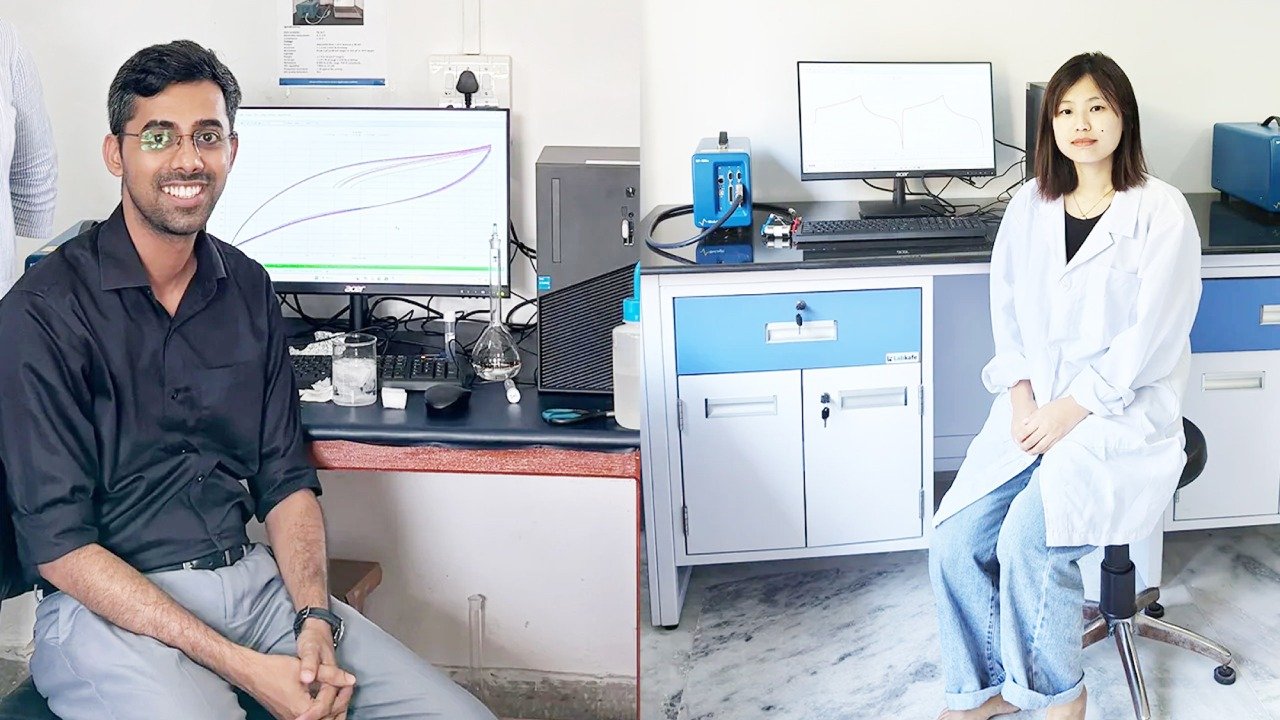
NEW DELHI, Oct 6: Researchers at Nagaland University have developed a flexible supercapacitor device capable of powering next-generation wearable electronics, electric vehicles (EVs), and renewable energy systems, a breakthrough that has the potential to transform energy storage technologies, according to officials.
This is a first-of-its-kind study to compare tungsten, vanadium, and cobalt doping in molybdenum diselenide for energy storage. Significantly, the researchers went beyond lab-scale material development and built a working prototype of the flexible supercapacitor, demonstrating its practical viability, they said.
While the immediate applications include health-monitoring devices, IoT gadgets, and robotics, the innovation also holds potential for electric vehicles. Such flexible supercapacitors could improve regenerative braking systems, provide quick acceleration boosts, and extend battery lifespans, they said.
Related Posts:



Vijeth H, Assistant Professor at Nagaland University, said such research could help India reduce dependence on imported batteries while boosting clean energy and storage technologies under the vision of ‘Aatmanirbhar Bharat’.
The findings of the research have been published in RSC Advances, a peer-reviewed scientific journal published by the Royal Society of Chemistry.
“This device combines flexibility, high energy storage, and durability, which are critical for future portable and wearable technologies. The study is the first to compare tungsten, vanadium, and cobalt doping in molybdenum diselenide for energy storage. Among them, cobalt proved most effective.
“The team used a simple, eco-friendly hydrothermal process to synthesise the material, making the innovation scalable for industrial adoption,” he said.
This research not only showcases scientific excellence from the North East but also strengthens India’s path toward sustainable and self-reliant energy solutions, the professor said.
Pewe-u Marhu, Research Scholar, Department of Physics, Nagaland University, explained that the next steps involve optimising the electrode–electrolyte interface, improving safety with solid-state gel electrolytes, and scaling up the process to pilot-level production.
“Industry collaborations are also being explored to bring the technology closer to commercialisation. The research was carried out entirely at Nagaland University with advanced characterisation support from the Indian Institute of Science (IISc) Bangalore through its INUP Program. “Funding came from the Anusandhan National Research Foundation (ANRF), which is also driving a national initiative on 2D materials,” Marhu said. (PTI)