
HT Bureau
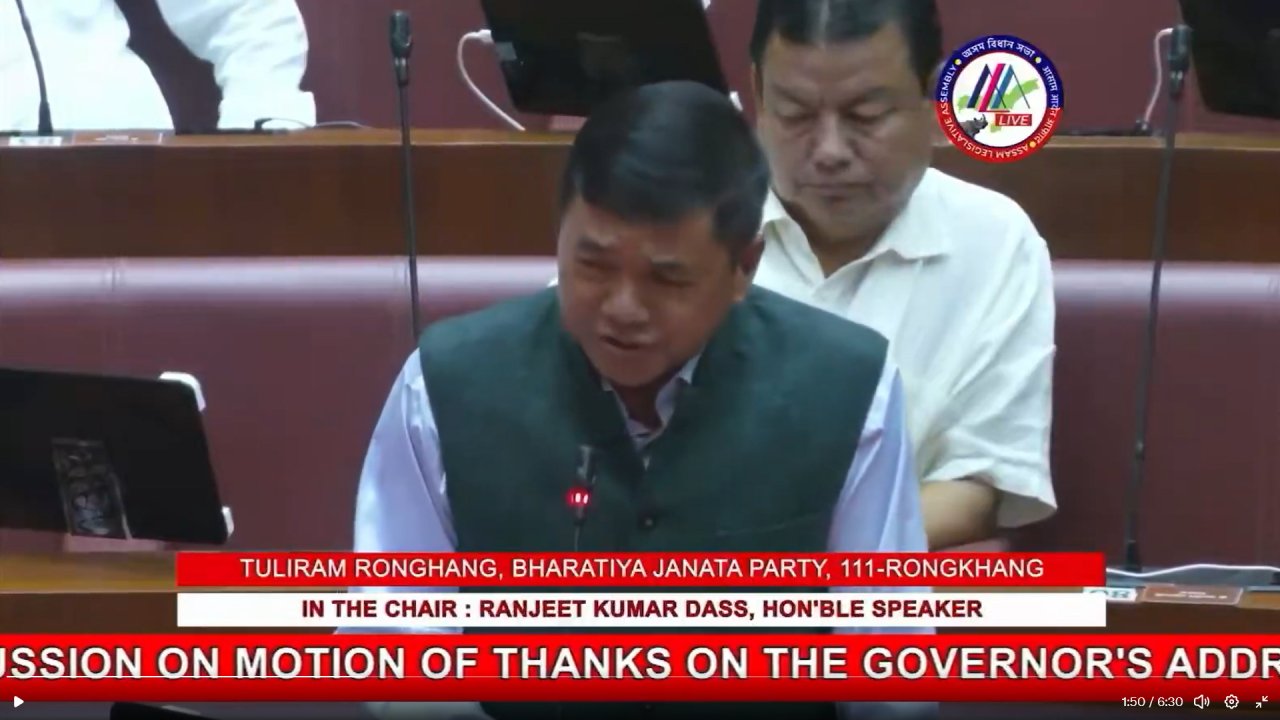
DIPHU, May 25: Tuliram Ronghang on Monday strongly raised the long-pending demand for an Autonomous State under Article 244(A) of the Constitution during the third day of the first session of the 16th Assam Legislative Assembly.
Ronghang, who is also the Chief Executive Member (CEM) of the Karbi Anglong Autonomous Council (KAAC), said the people of Karbi Anglong, West Karbi Anglong and Dima Hasao districts have been demanding an Autonomous State for the last 40 years.
Related Posts:

He clarified that the demand was not for separation from Assam, but for a “state within a state”, with the hill districts continuing to remain part of Assam.
Highlighting the geographical significance of the region, Ronghang pointed out that Karbi Anglong’s area of 10,434 square kilometres is larger than states like Sikkim, Goa and Tripura.
Referring to a past meeting at the PWD Guest House in Guwahati, Ronghang reminded Assembly Speaker Ranjeet Kumar Dass that when he was BJP state president, a resolution supporting the Autonomous State demand had been adopted without objection, along with an assurance to raise the matter before the State and Central governments.
Ronghang further stated that the prolonged movement over the issue had led to the emergence of 10 insurgent groups and claimed that over 500 people lost their lives during the agitation.
He alleged that the previous Congress government had failed to provide compensation to affected families, while the present BJP government under Chief Minister Himanta Biswa Sarma provided ₹5 lakh each to families of deceased cadres.
He also referred to the peace accord signed between insurgent groups and the Centre under the leadership of Union Home Minister Amit Shah and Chief Minister Himanta Biswa Sarma, expressing confidence that the present BJP government would ultimately resolve the political issue. Ronghang additionally praised the Chief Minister’s initiative allowing MLAs to take oath in their mother tongues on May 21, describing it as a historic step towards recognising and promoting the languages of various indigenous communities and tribes in the state.